


The O/C/O platform.
Eight connected systems. One operational picture. Plan, execute and adapt offensive cyber operations with the capability depth and control to match any adversary.
Eight connected systems.
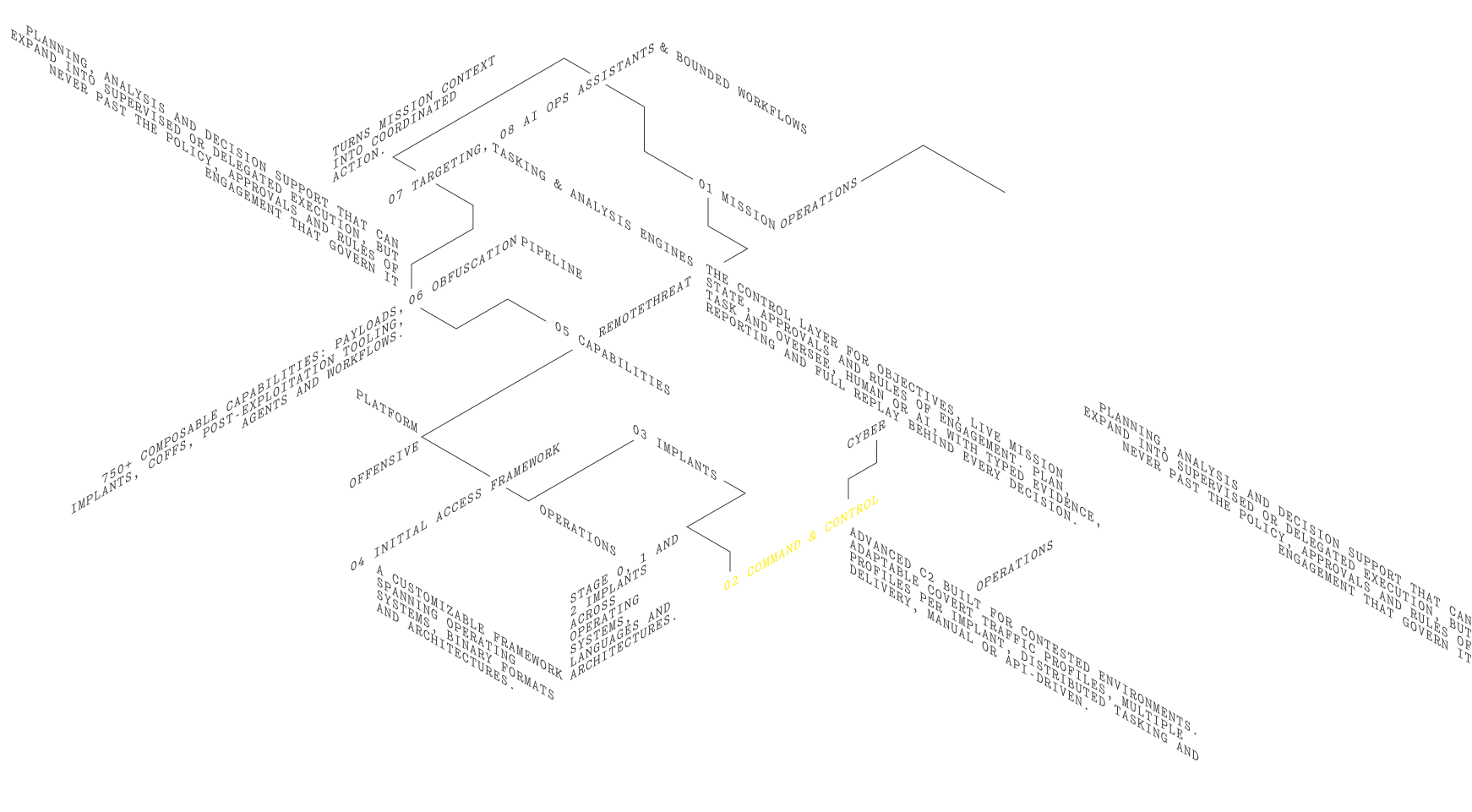
Mission Operations
Keep the objective, operators and execution aligned. Plan missions, coordinate tasks and oversee live operations with Rules of Engagement, approvals and evidence connected throughout.
Mission planning. Live operational context. Approvals and auditability.
Command & Control
Coordinate implants and tasks through adaptable communications built for contested environments. Configure traffic profiles, distribute tasking and control execution directly or through APIs, alongside the C2 your team already uses.
Adaptable traffic profiles. Distributed tasking. Manual and API control.
Implants
Configure access around the environment and objective. Stage 0, 1 and 2 implants span operating systems and architectures. Reconfigure components and communications to fit the operation.
Cross-platform access. Reconfigurable components. In-memory execution.
Initial Access Framework
Build the starting point for the operation. Compose local and remote execution primitives across operating systems, binary formats and architectures. Apply guardrails that constrain execution to the intended conditions.
Execution primitives. Configurable guardrails. API-callable capabilities.
Capabilities
Put advanced tradecraft to work. Select and combine payloads, implants, post-exploitation tools and workflows to match the target environment, adversary sophistication and mission objective.
Composable tooling. Mission-specific configurations. Human and AI callable.
Obfuscation Pipeline
Adapt the build to the operation. Customize payloads, implants and tools with configurable obfuscation and evasion techniques that reflect the target environment and required level of sophistication.
Operation-specific builds. Control-flow obfuscation. Configurable evasion.
Targeting, Tasking & Analysis Engines
Turn mission context into coordinated action. Develop targets, break objectives into tasks and correlate findings across the operation. Preserve context as evidence develops and the mission changes.
Target development. Task coordination. Evidence-based analysis.
AI Ops Assistants & Bounded Workflows
Extend operator judgment with AI assistance for planning, analysis and execution. Delegate defined tasks within mission context, policy, approvals and Rules of Engagement. Match oversight to the operation.
Planning and decision support. Supervised execution. Bounded delegation.
Arsenal. Next-era offense.
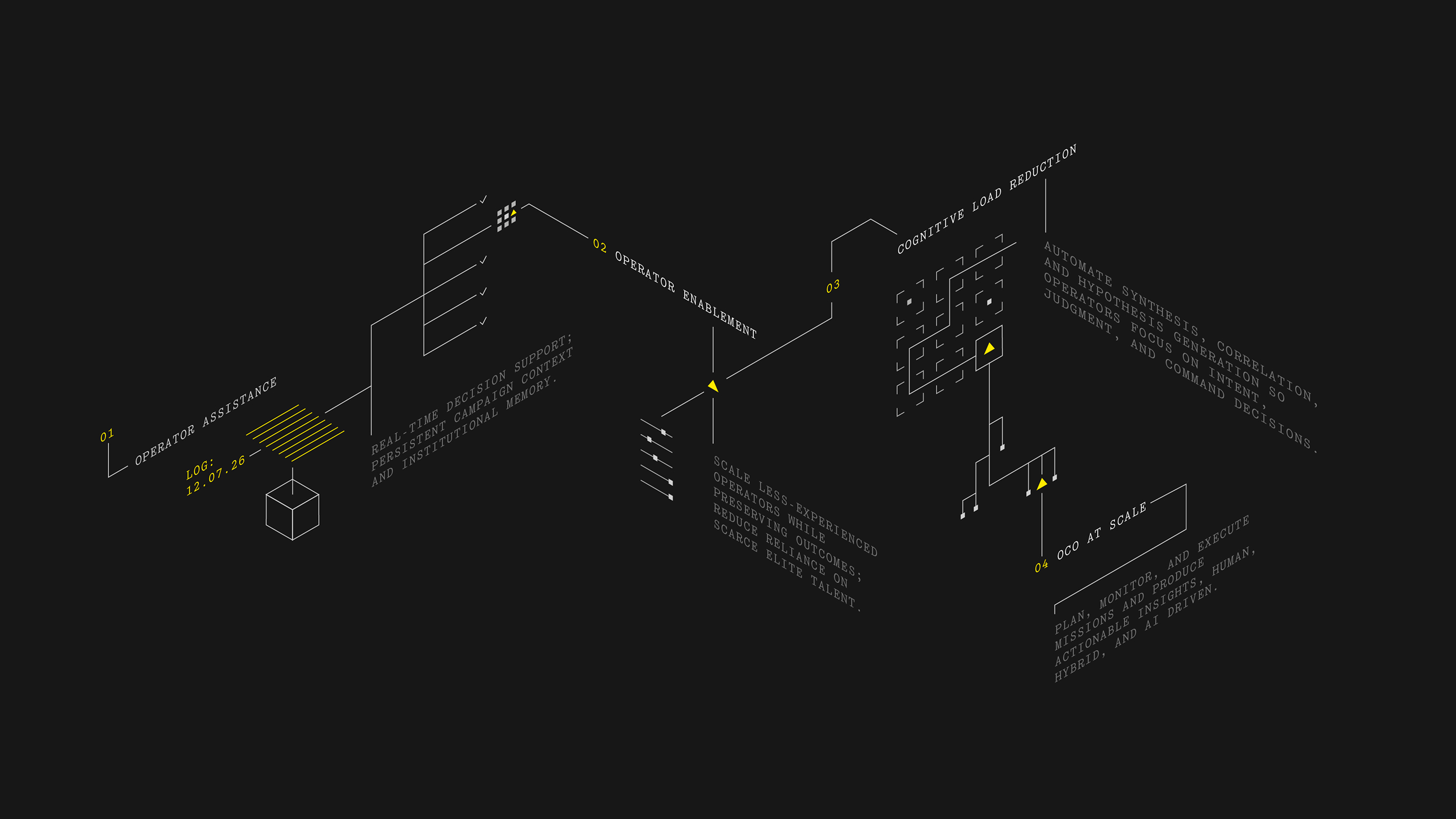
Operators select, combine, customize, build and obfuscate capabilities for the target environment, mission and required level of sophistication.
Configured for the mission.
Mission Calibration

Match the operation to the adversary. Configure capability depth, payloads, implants, infrastructure and autonomy around the objective. Balance speed, stealth and persistence. Adapt as defenses respond and access changes.
Governance
Define the boundaries before execution. Rules of Engagement, policy, approvals and No-Strike controls constrain consequential actions. Keep operator decisions, delegated tasks and supporting evidence traceable throughout the mission.
Deployment
Deploy where the mission requires. Run in the cloud, on-premises or in air-gapped environments. Connect existing C2, tools, infrastructure and customer-selected models through capability-level APIs and SDKs.
Close
Connect execution to the decisions that matter. Use operational evidence to validate exploitable risk, assess control performance and evaluate team readiness. Prioritize improvements and measure progress across successive engagements.